Address
No.55-6, Denggang, Middle of Lishui Avenue, Lishui Town, Nanhai District, Foshan City, Guangdong Province, China.
Work Hours
Mon to Fri: 7:00AM - 18:00PM
Weekend: 10:00AM - 18:00PM

Address
No.55-6, Denggang, Middle of Lishui Avenue, Lishui Town, Nanhai District, Foshan City, Guangdong Province, China.
Work Hours
Mon to Fri: 7:00AM - 18:00PM
Weekend: 10:00AM - 18:00PM


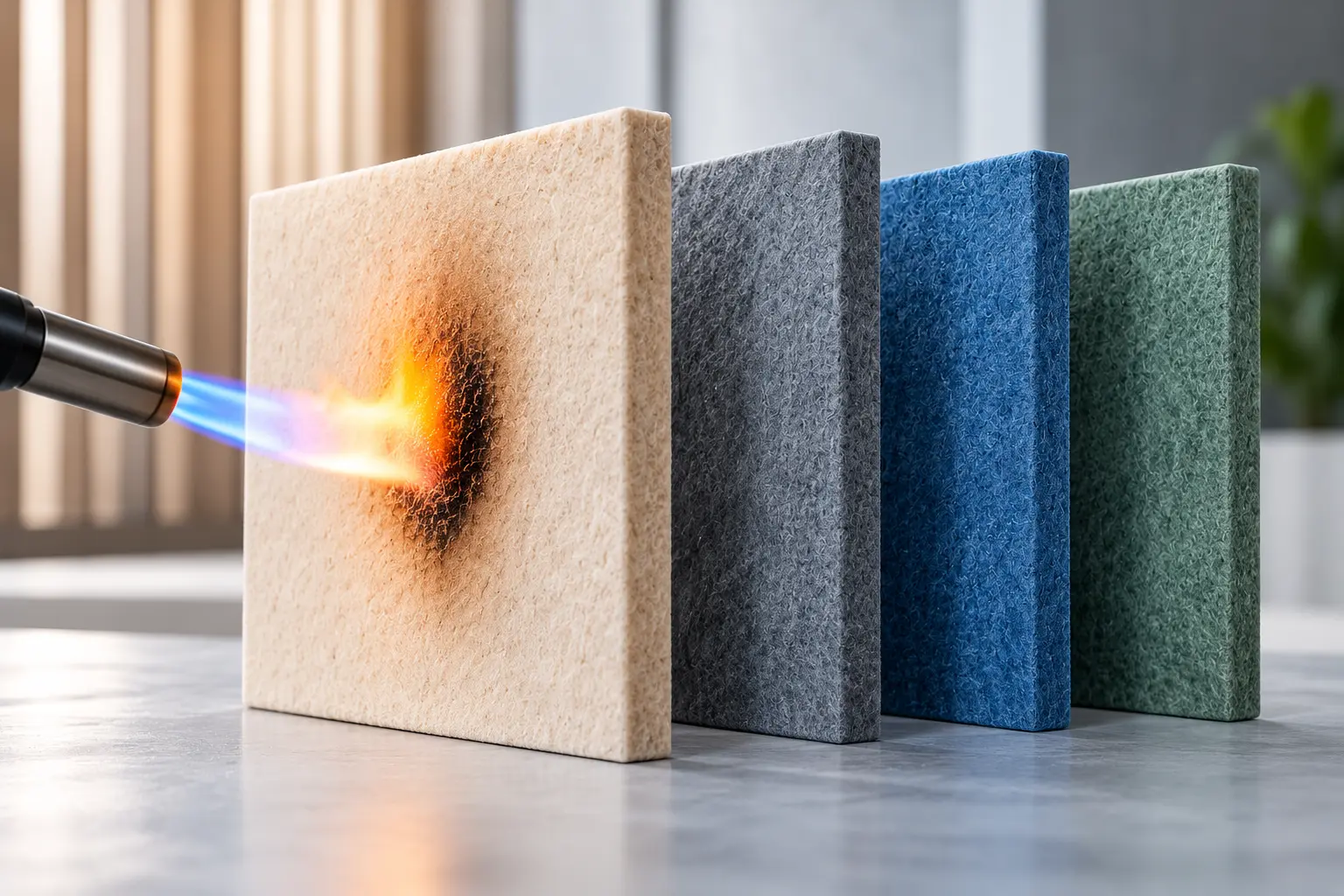
When choosing acoustic panels for commercial projects, fire performance is an important consideration. Many buyers look for B1 fire-rated acoustic panels, but a B1 classification does not mean the material is completely fireproof.
Understanding what B1 means can help architects, contractors, and project buyers select suitable acoustic materials for different interior applications.
Under China’s GB 8624 fire classification system, B1 refers to flame-retardant building materials that meet specific reaction-to-fire requirements.
Compared with ordinary combustible materials, B1-rated products demonstrate more limited fire development under the relevant test conditions. Depending on the material and its construction, the panels may char, shrink, or experience other changes when exposed to flames.
However, B1 does not mean non-combustible. Continuous exposure to high temperatures or intense flames can still damage the material.
The actual fire performance depends on the panel composition, thickness, manufacturing process, and installation conditions.
Not necessarily.
Some manufacturers apply flame-retardant treatments to finished acoustic panels, while others incorporate flame-retardant additives during material production.
Surface treatments may offer effective fire protection, but their long-term durability depends on the chemical formulation, application process, moisture exposure, and environmental conditions.
Incorporating flame-retardant additives during manufacturing can provide another approach to improving material performance. However, neither method automatically guarantees a B1 classification.
For commercial projects, buyers should request third-party fire-test reports that match the actual acoustic panel specification.
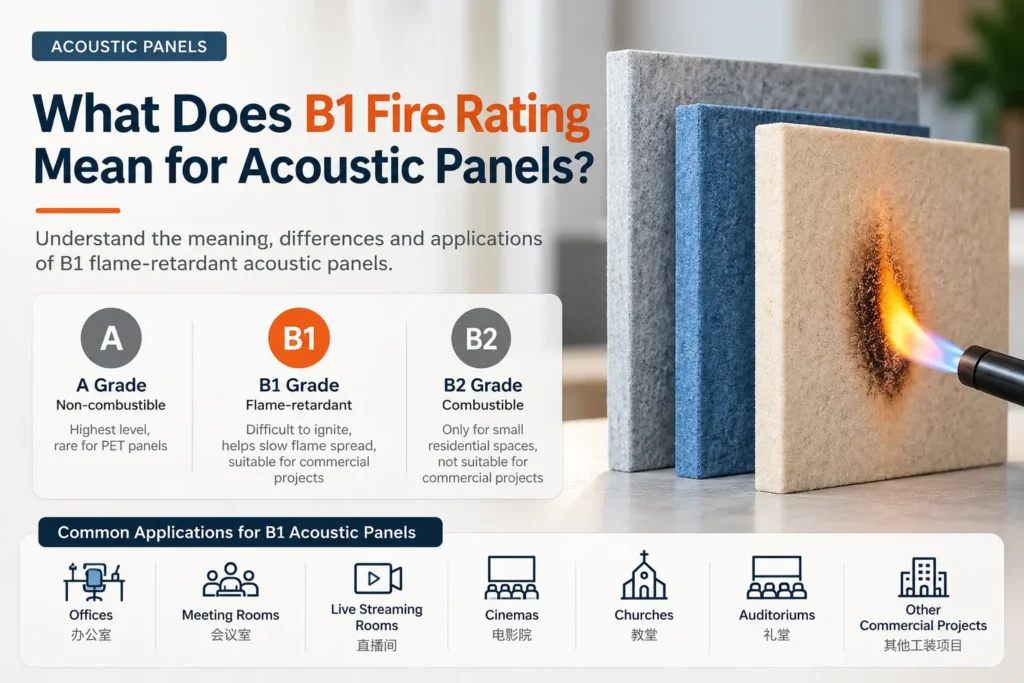
Different fire classifications indicate different levels of reaction-to-fire performance under the applicable Chinese standard.
| Fire Rating | Classification | Typical Considerations |
|---|---|---|
| A | Non-combustible | Projects with stringent non-combustibility requirements |
| B1 | Flame-retardant | Commercial interiors where the applicable specifications permit B1-rated materials |
| B2 | Combustible | Applications where building codes permit this classification |
Most conventional polyester fiber acoustic panels do not qualify as Class A non-combustible materials. Manufacturers may instead offer flame-retardant PET acoustic panels with verified B1 performance, depending on the formulation and product specification.
B1-rated acoustic panels may suit a range of commercial and architectural projects, provided they meet the applicable local fire requirements.
Typical applications include:
Fire-rating requirements vary by country, building type, occupancy, and installation location. A B1 rating alone does not guarantee approval for every project.
For overseas projects, buyers should also note that China’s GB 8624 classifications are not directly equivalent to European EN 13501-1 or American ASTM E84 classifications.
B1 fire-rated acoustic panels offer a flame-retardant material option, but they are not completely fireproof.
When selecting PET acoustic panels or other sound-absorbing materials, consider the product’s fire-test documentation, acoustic performance, installation method, and project requirements rather than relying on the B1 label alone.
ES Acoustic supports commercial acoustic projects with material selection, custom panel configurations, and technical documentation according to product specifications.
Explore Our PET Acoustic Wall Panels | Contact ES Acoustic