Address
No.55-6, Denggang, Middle of Lishui Avenue, Lishui Town, Nanhai District, Foshan City, Guangdong Province, China.
Work Hours
Mon to Fri: 7:00AM - 18:00PM
Weekend: 10:00AM - 18:00PM

Address
No.55-6, Denggang, Middle of Lishui Avenue, Lishui Town, Nanhai District, Foshan City, Guangdong Province, China.
Work Hours
Mon to Fri: 7:00AM - 18:00PM
Weekend: 10:00AM - 18:00PM


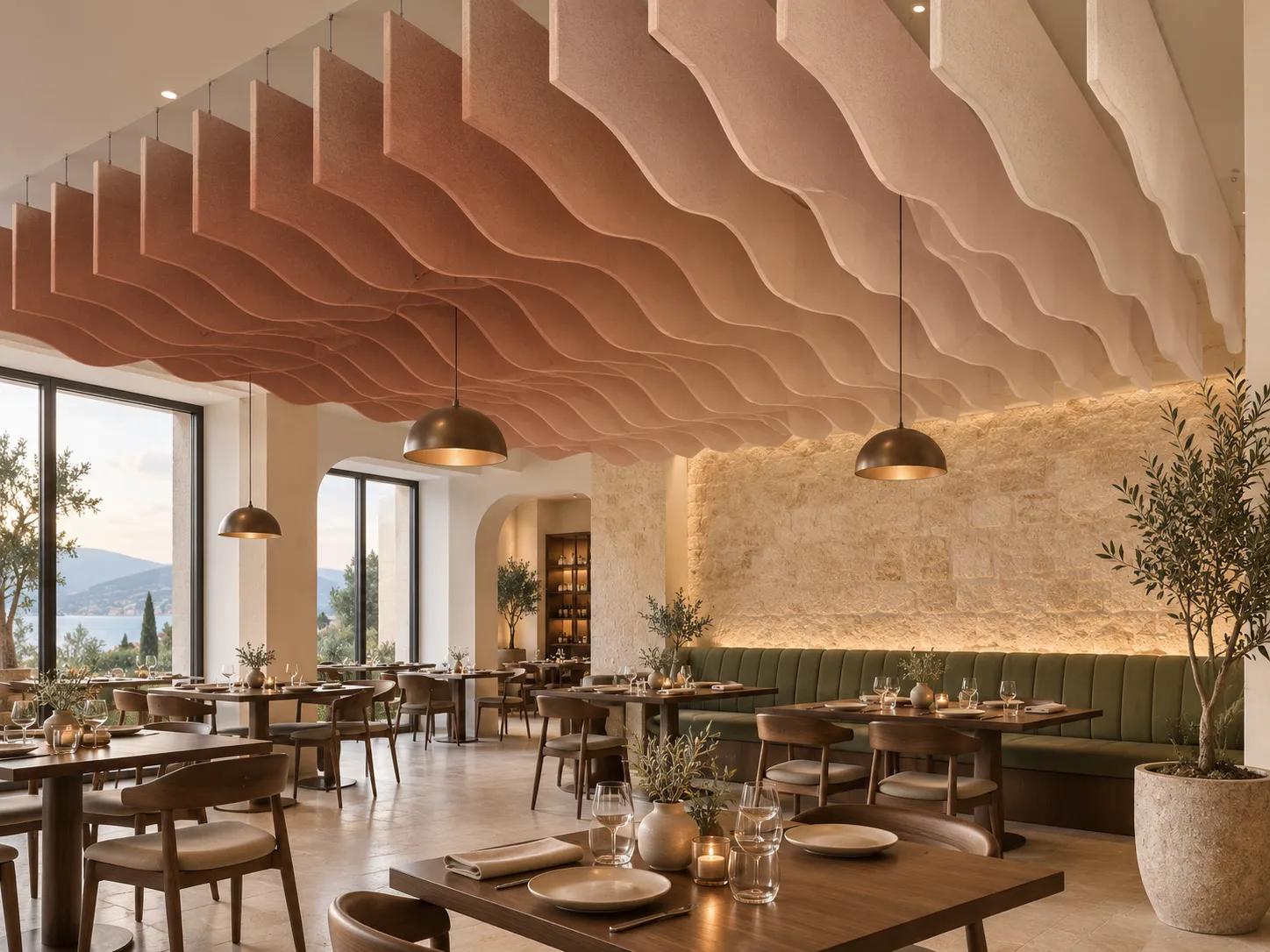

Suspended acoustic baffles help reduce reverberation in spaces with hard surfaces, open ceilings, and large room volumes. Among the most common options, PET acoustic ceiling baffles and fiberglass acoustic ceiling baffles both provide effective sound absorption, but they differ in material structure, appearance, customization, and typical applications.
Choosing between the two depends on more than the material itself. Ceiling height, room size, acoustic targets, fire requirements, visual design, suspension layout, and budget all influence the final decision.
PET acoustic ceiling baffles use polyester fiber felt as the main material. Their lightweight structure works well in modern commercial interiors where acoustic treatment also forms part of the ceiling design.
PET gives designers more freedom in shape and color. CNC cutting makes it easier to create straight, curved, wave, geometric, or custom profiles, while the wide color range supports branding and interior coordination. This makes PET acoustic baffles a strong choice for offices, schools, restaurants, hotels, retail spaces, and other design-focused environments.
They also integrate well with open ceilings, lighting, HVAC systems, sprinklers, and exposed services.
Fiberglass acoustic ceiling baffles usually use a high-density fiberglass core with an acoustically transparent fabric finish. Compared with thin PET felt elements, fiberglass baffles often use a thicker construction and focus more strongly on sound absorption than complex decorative forms.
They work well in auditoriums, conference spaces, gymnasiums, multipurpose halls, public buildings, and other large interiors where reverberation control plays a major role.
The fabric finish also gives designers flexibility in color and texture, although the product shape usually stays more linear or rectangular.
The two materials solve similar acoustic problems, but they approach ceiling design differently.
这个变成表格PET vs Fiberglass Acoustic Ceiling Baffles
The two materials solve similar acoustic problems, but they approach ceiling design differently.
| FeaturePET Acoustic Ceiling BafflesFiberglass Acoustic Ceiling Baffles | ||
|---|---|---|
| Main Material | Polyester Fiber / PET Felt | High-Density Fiberglass Core |
| Typical Appearance | Slim and architectural | Thicker and more substantial |
| Shape Flexibility | High | Mainly linear or rectangular |
| CNC Cutting | Excellent | More limited |
| Color Options | Wide PET color range | Fabric finish options |
| Weight | Lightweight | Generally heavier than thin PET felt |
| Design Freedom | Very high | Moderate |
| Typical Spaces | Offices, schools, hospitality, retail | Auditoriums, halls, gyms, commercial spaces |
| Main Strength | Architectural flexibility | Strong absorptive construction |
| Installation | Cable / Rail / Custom Suspension | Cable / Wire / Custom Suspension |
Neither material automatically performs better in every project. The final result depends on the complete system, including material thickness, density, baffle dimensions, spacing, suspension height, quantity, room volume, and installation configuration.
Choose PET acoustic ceiling baffles when the project needs lightweight construction, custom shapes, multiple colors, or a more architectural ceiling appearance. They are especially suitable for offices, schools, hospitality spaces, retail environments, and other interiors where acoustic treatment needs to blend with design.
Choose fiberglass acoustic ceiling baffles when the project requires thicker absorptive elements and strong reverberation control in larger spaces such as auditoriums, gyms, conference halls, and public buildings.
For many commercial projects, the best choice comes from balancing acoustic performance with appearance, installation conditions, ceiling structure, maintenance, and fire requirements.
Material choice is only one part of the acoustic design. Baffle thickness, size, spacing, drop height, orientation, and total ceiling coverage all affect performance.
A thinner PET baffle system and a thicker fiberglass system may behave differently, but proper layout often matters just as much as material selection. For important projects, review tested acoustic data and installation conditions instead of comparing products only by material name.
Start with the project requirements rather than the material.
Ask these questions:
A large auditorium and a small office may both use ceiling baffles, but they require very different layouts.
If the ceiling forms a major part of the architectural concept, PET gives you more freedom with color, shape, and visual rhythm.
Lighting, ducts, sprinklers, structural beams, cable trays, and other services affect baffle positioning.
Reverberation targets and room volume should influence the quantity, dimensions, spacing, and material configuration.
Confirm the required standard before finalizing the material specification.
PET usually works better for complex CNC-cut profiles, while fiberglass works well for conventional linear suspended absorbers.
Both PET acoustic ceiling baffles and fiberglass acoustic ceiling baffles offer practical solutions for reducing reverberation in commercial and architectural spaces.
PET provides greater design flexibility, lightweight construction, and more shape options, while fiberglass offers a thicker absorptive structure and suits many large-volume interiors.
ES Acoustic provides suspended acoustic baffles in PET and fiberglass configurations and supports custom sizes, colors, suspension layouts, and project-specific acoustic solutions.
For project recommendations, share your room dimensions, ceiling height, drawings, acoustic requirements, and preferred material with our team.
Explore Suspended Acoustic Baffles →