Address
No.55-6, Denggang, Middle of Lishui Avenue, Lishui Town, Nanhai District, Foshan City, Guangdong Province, China.
Work Hours
Mon to Fri: 7:00AM - 18:00PM
Weekend: 10:00AM - 18:00PM

Address
No.55-6, Denggang, Middle of Lishui Avenue, Lishui Town, Nanhai District, Foshan City, Guangdong Province, China.
Work Hours
Mon to Fri: 7:00AM - 18:00PM
Weekend: 10:00AM - 18:00PM


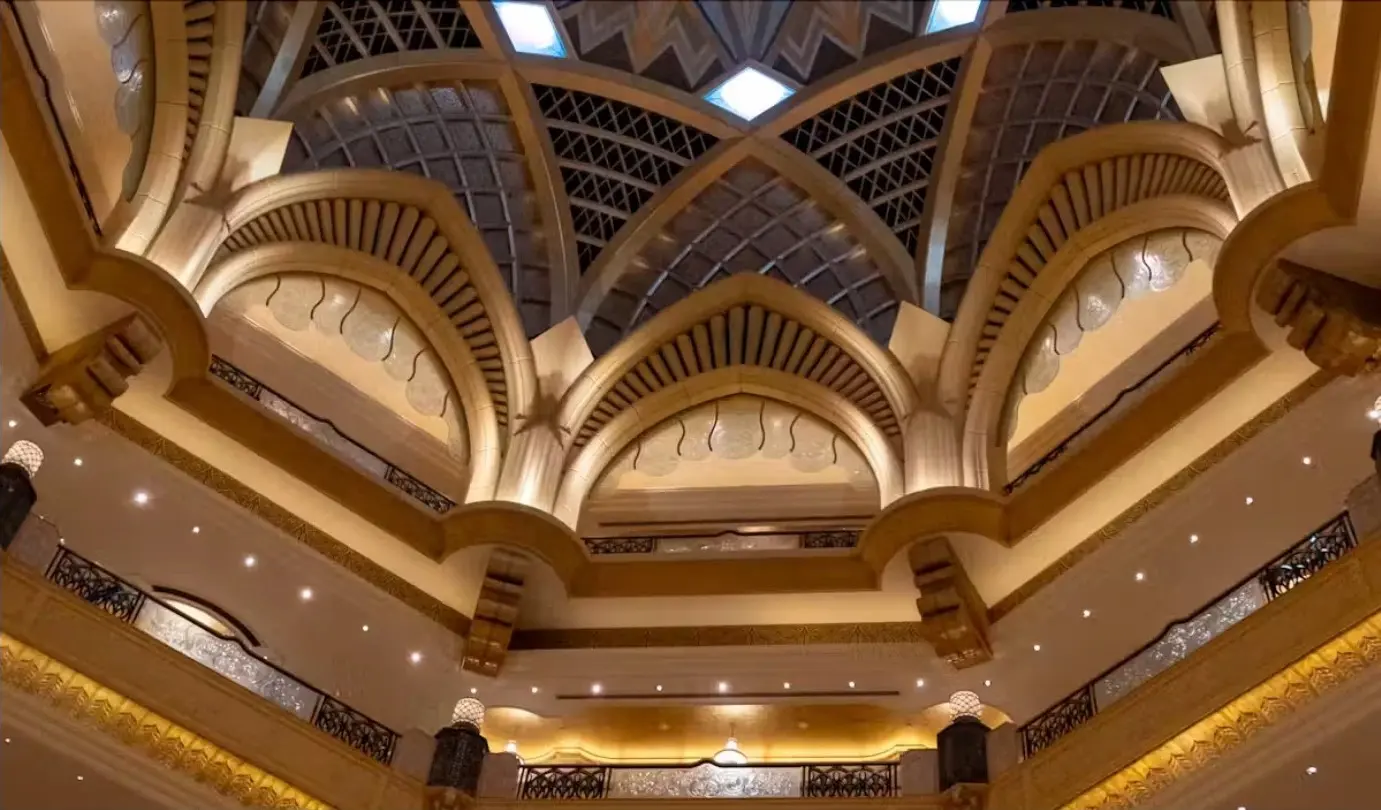
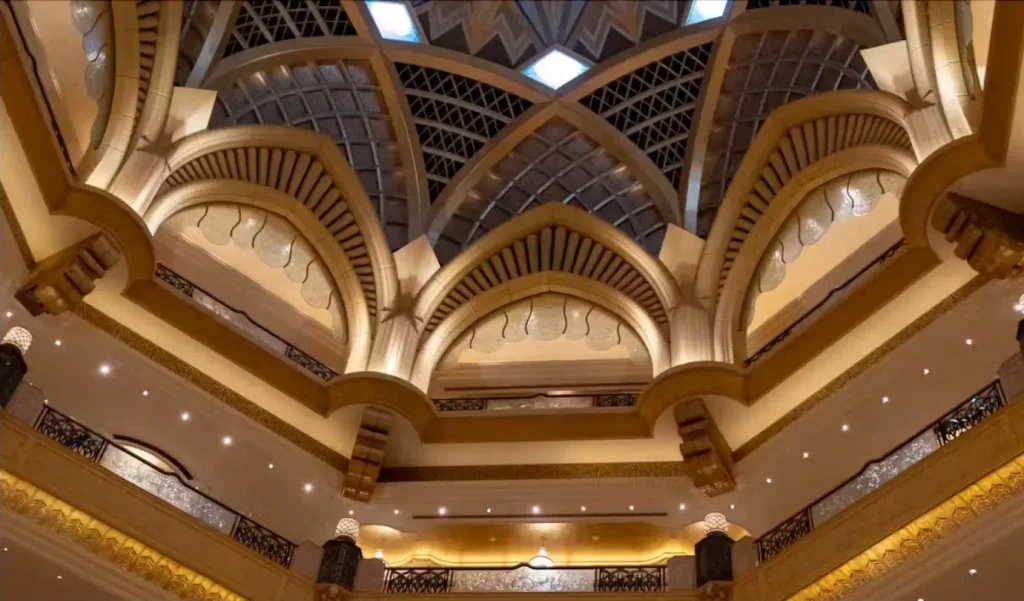
Why can a quiet string passage remain distinct in a concert hall while a full orchestra seems to fill the room? Much depends on how the space retains, redirects and absorbs sound energy. Good concert hall acoustics bring direct sound, early reflections and later reverberation into a useful relationship. More absorption, greater loudness or a longer reverberant tail is not automatically better. This guide uses three diagrams to explain the design principles that architects, interior designers and project buyers should understand before selecting materials.
Sound travels from the stage along several paths. Direct sound arrives without a reflection. Early reflections follow after bouncing off surfaces such as walls, ceilings or reflector panels. Repeated reflections contribute to a decaying reverberant field. Listeners normally hear these components together as music, rather than as three separately identifiable events.
For the musical clarity parameter C80, the arrival of direct sound is the time reference. Sound energy within the first 80 milliseconds is compared with energy arriving later. This is an analysis convention, not a sudden boundary in human hearing or a rule that makes every early reflection beneficial. Direction, level, frequency content and the music itself also matter. [1]
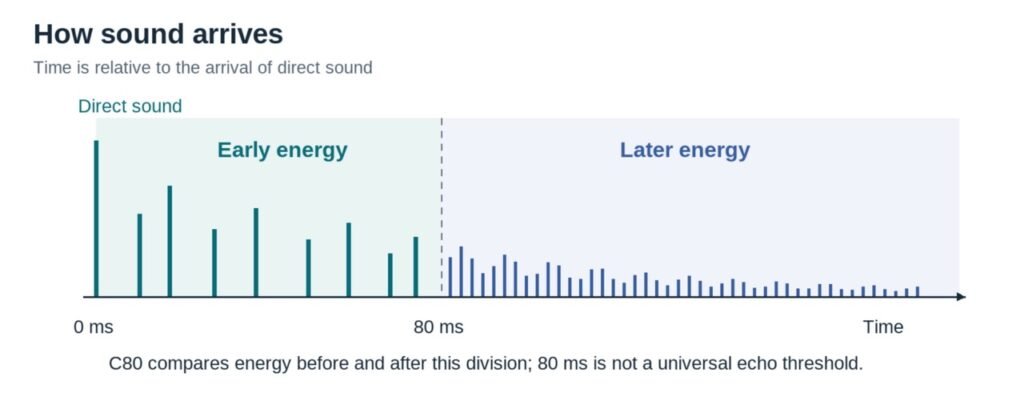
Figure 1. A conceptual arrival sequence. Zero milliseconds marks the arrival of direct sound, not the instant sound leaves the stage.
An overhead stage canopy, together with suitable wall and ceiling surfaces, can redirect some sound toward the audience and return useful sound to the musicians. Its effect depends on geometry, dimensions, position and construction. A passive reflector does not add electronic gain like a sound reinforcement system.
The practical questions are which seats receive useful reflections, when those reflections arrive, and whether performers can hear one another. Appearance or mounting height alone cannot guarantee clarity in the back row. Where a system is adjustable, its settings should be checked against the intended performance modes.
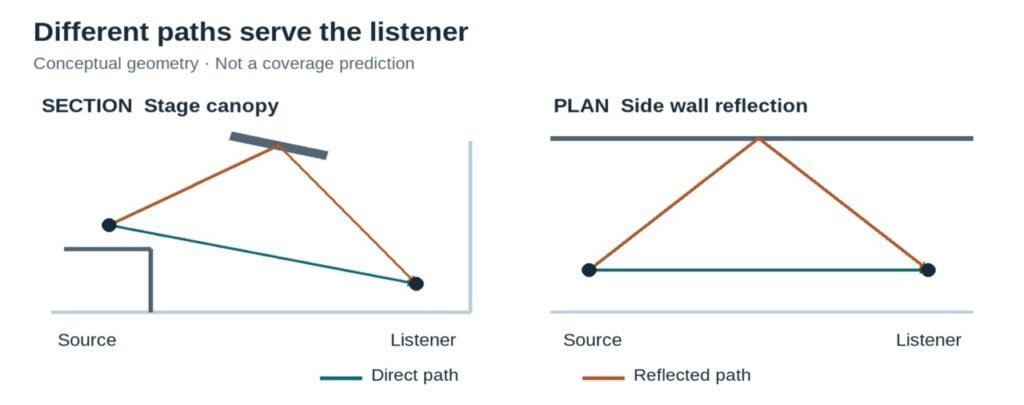
Sound arriving from the sides contributes strongly to spatial impression. Earlier lateral reflections are associated with apparent source width, while later lateral energy is more closely associated with listener envelopment. A single reverberation-time value therefore cannot describe the full balance between definition and spaciousness. [1]
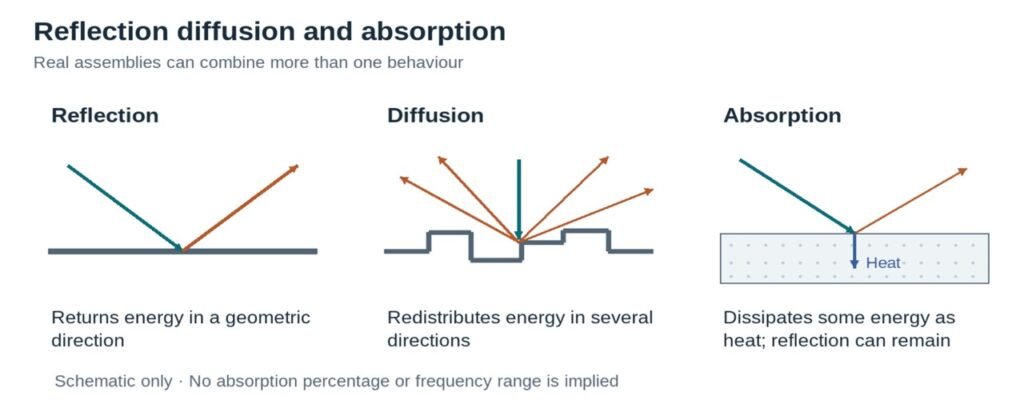
Large concave surfaces can concentrate reflected sound in particular areas. Changes to room geometry, segmented surfaces or appropriate diffusion can help address problematic reflections. Diffusion redistributes sound rather than simply absorbing it. Small surface textures do not necessarily work at every frequency, and adding diffusion indiscriminately can weaken reflections that the room needs. [1]
Reverberation time describes the time corresponding to a 60 dB decay after the sound source stops; measurements may estimate it from a shorter decay range. A longer decay can support musical sustain but may obscure rapid passages. A shorter decay may reveal certain details without being the right choice for every programme or room. The target should follow the intended use and listening experience. [1]
When discussing a target, state the musical programme, room volume, frequency bands, measurement method and whether the room is occupied. Seating, people, curtains and stage arrangements should be included in the assessment. A fixed allowance such as a 0.2-second change for scenery is not a general design rule. Opera, symphonic music, speech and amplified events should not automatically share the same brief.
Wood finishes can provide decoration, reflection or absorption, depending on panel mass, stiffness, openings, backing and mounting. Wood does not automatically create a warm sound, just as a higher absorption rating does not automatically produce a better concert hall.
First establish whether a surface should preserve a reflection, scatter energy or absorb selected frequencies. Then review test data for the proposed assembly. The comparison below distinguishes possible roles; it is not a declaration of performance for any ES Acoustic product.
| Material or assembly | Possible acoustic role | Checks before selection |
| Solid wood finish or rigid reflector | Preserve and direct reflections | Mass, stiffness, dimensions, mounting and placement |
| Perforated or slotted wood system | Absorption with a suitable backing and cavity | Opening geometry, backing, cavity depth and frequency data |
| Fabric wrapped or PET fibre system | Porous absorption in selected areas | Thickness, coverage, mounting gap and tested assembly |
| Microperforated metal system | Absorption through a designed panel and cavity | Hole size, open area, panel thickness, cavity and any backing |
| Diffusive or segmented surface | Redistribute reflected sound | Scale, effective frequencies, location and useful reflections |
For a new concert hall or an auditorium refurbishment, a clear brief is more useful than asking for the best panel. Share the following with the acoustic consultant and material supplier:
Room absorption is only part of the task. External noise, building-services noise, sound isolation and structural vibration need separate attention; one acoustic panel cannot resolve them all.
No. Absorption should address the required areas and frequencies while working with reflection and diffusion. Adding extensive absorption without an assessment can change the loudness and reverberation balance needed for music.
No. The 80-millisecond division is used in C80. Whether a reflection is heard as a separate echo also depends on its level, delay, the sound being played and masking by other reflections.
Listen for distinct note onsets, separation during loud passages and a smooth decay during permitted quiet pauses. If possible, compare similar performances from different seats. Listening complements measurement; there is no need to clap or otherwise interrupt a performance to test the room.
Planning a concert hall, auditorium or multipurpose venue? If it would be useful, ES Acoustic can review your drawings, preferred finishes, proposed treatment areas and acoustic consultant’s requirements. Our team can then suggest material options, samples, dimensions and fabrication details for the next stage of review. Final acoustic strategies and installation assemblies should be confirmed by the project design team.
[1] Kelsey A. Hochgraf, The Art of Concert Hall Acoustics: Current Trends and Questions in Research and Design, Acoustics Today, Spring 2019, 15(1), pp. 28–36. Read Kelsey A. Hochgraf’s overview of current research and design questions in concert hall acoustics in Acoustics Today.