Address
No.55-6, Denggang, Middle of Lishui Avenue, Lishui Town, Nanhai District, Foshan City, Guangdong Province, China.
Work Hours
Mon to Fri: 7:00AM - 18:00PM
Weekend: 10:00AM - 18:00PM

Address
No.55-6, Denggang, Middle of Lishui Avenue, Lishui Town, Nanhai District, Foshan City, Guangdong Province, China.
Work Hours
Mon to Fri: 7:00AM - 18:00PM
Weekend: 10:00AM - 18:00PM


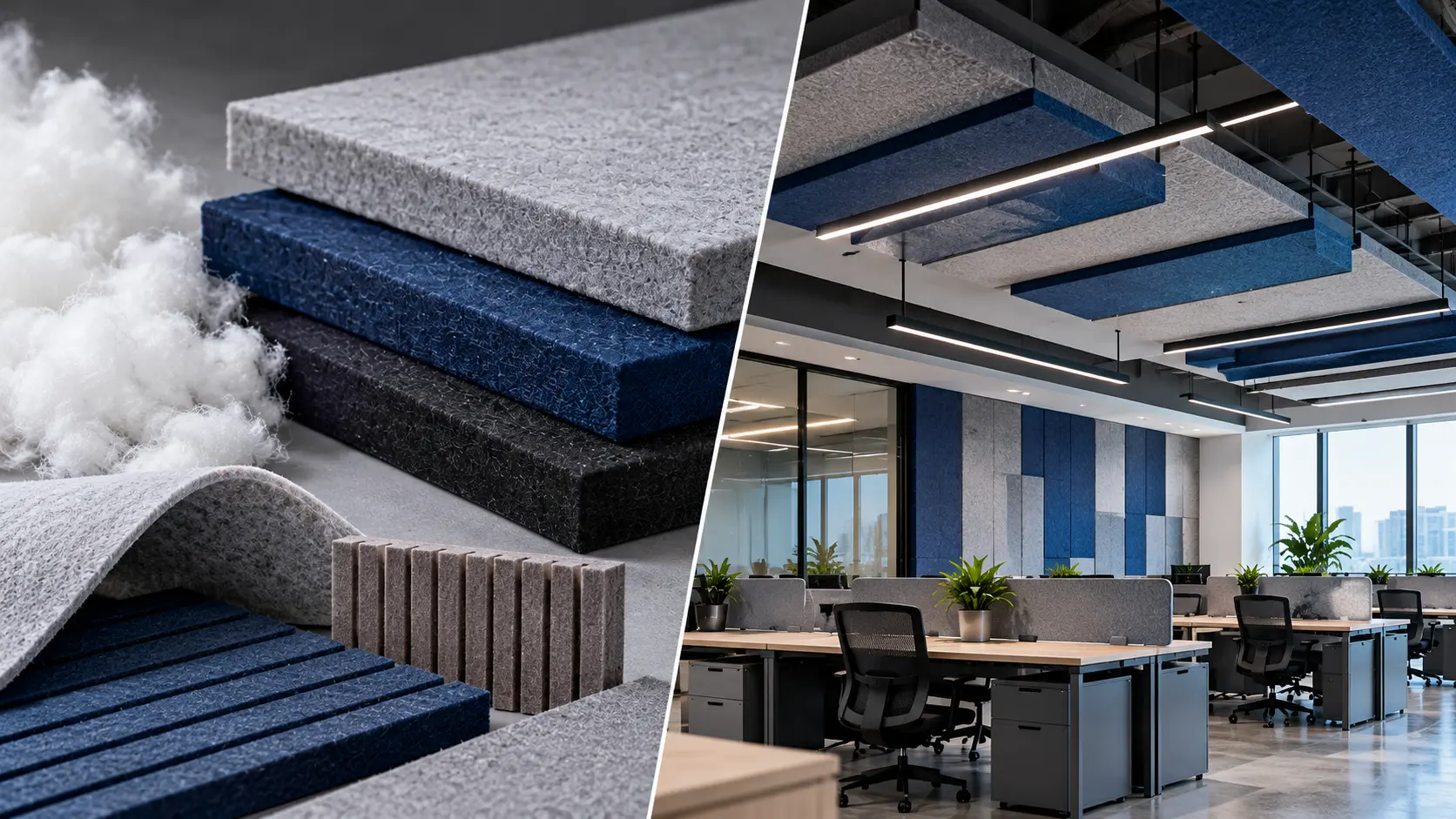
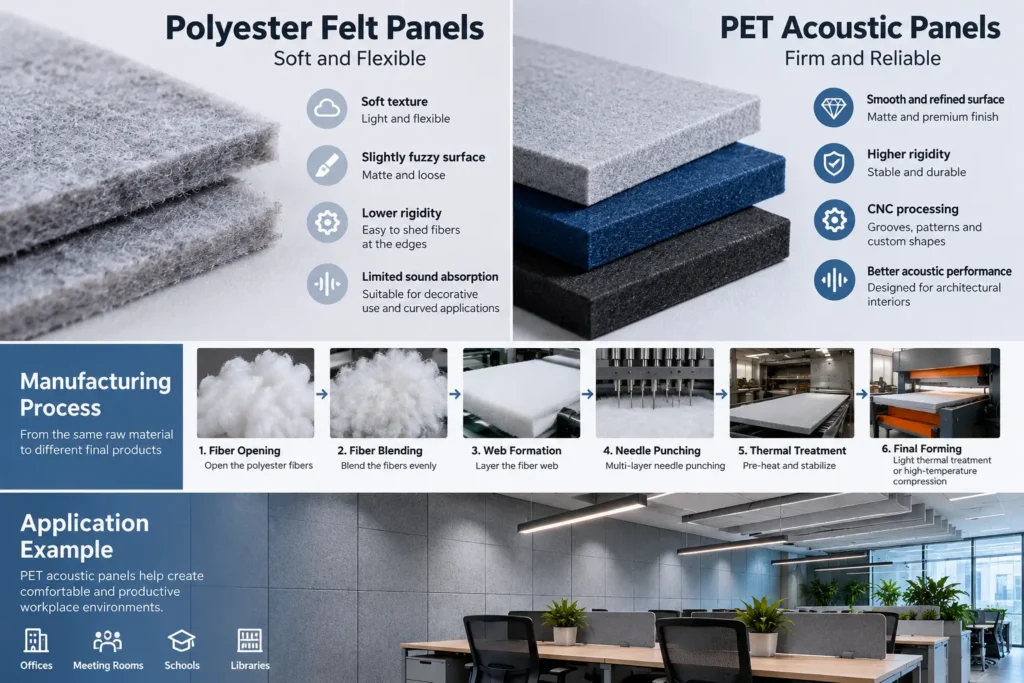
Are polyester felt panels and polyester acoustic panels really the same material?
They may look similar, and both can use 100% polyester (PET) fibers. However, differences in manufacturing, fiber density, surface finish, and panel structure can affect their appearance, rigidity, acoustic performance, and applications.
Understanding how manufacturers produce these materials helps architects, contractors, and interior designers choose the right PET panels for their projects.
Both products can follow a similar manufacturing process, starting with polyester fibers and moving through several nonwoven production stages:
Fiber Opening → Fiber Blending → Web Formation → Needle Punching → Thermal Treatment → Final Forming
During production, manufacturers open and blend the fibers, arrange them into layered webs, and use needle punching to create an interconnected fiber structure. Thermal processing then helps stabilize the material.
One important difference often appears during the final forming stage. Manufacturers may use relatively light thermal treatment to retain a soft, flexible felt structure or apply controlled heat and compression to create a firmer, more dimensionally stable acoustic panel.
The final material properties also depend on the fiber composition, needling process, thickness, density, and manufacturing conditions.
Conventional polyester felt typically retains a softer and more flexible fiber structure. Depending on its manufacturing quality, the surface may feel slightly fuzzy or less compact than a rigid architectural acoustic panel.
Common characteristics include:
Polyester felt works well for decorative coverings, flexible interior elements, and applications that require a softer material.
However, some lightweight felt products may lack the structural rigidity required for freestanding panels, precise grooves, or detailed architectural patterns.
Manufacturers can use controlled heat and compression to produce firmer PET acoustic panels with a more consistent surface and defined shape.
This manufacturing approach creates a compact, stable fiber structure while retaining the porosity needed for sound absorption.
Typical characteristics include:
High-density PET acoustic panels suit commercial interiors where designers require acoustic treatment alongside clean architectural finishes.
ES Acoustic offers polyester acoustic panel solutions for offices, meeting rooms, schools, libraries, auditoriums, and other commercial environments.
| Feature | Conventional Polyester Felt | High-Density PET Acoustic Panels |
|---|---|---|
| Base Material | Polyester (PET) Fibers | Polyester (PET) Fibers |
| Typical Structure | Softer, More Flexible | Firmer, More Dimensionally Stable |
| Final Forming | Light Thermal Treatment or Other Felt Finishing | Controlled Thermal Bonding and Compression |
| Surface Finish | Soft, Felt-Like Texture | More Uniform, Refined Matte Finish |
| Rigidity | Generally Lower | Generally Higher |
| Shape Processing | Flexible Coverings and Selected Custom Shapes | CNC Cutting, Grooves, Decorative Patterns |
| Sound Absorption | Depends on Product Construction and Installation | Depends on Product Construction and Installation |
| Typical Applications | Decorative Felt, Flexible Interior Elements | Architectural Acoustic Walls and Ceilings |
Not necessarily.
PET acoustic panels absorb sound through their porous fiber structure. Fiber arrangement and airflow resistance influence how effectively the material absorbs sound energy.
Density affects this behavior, but higher density alone does not guarantee a higher Noise Reduction Coefficient (NRC). Excessive compression may reduce the open structure that contributes to sound absorption.
Panel thickness, fiber construction, mounting method, and the air cavity behind the panel also play important roles.
For commercial acoustic projects, architects and contractors should compare laboratory sound absorption data for the actual product and installation configuration rather than selecting panels based on density alone.
High-density PET acoustic panels offer a practical combination of architectural flexibility and sound absorption for many commercial interiors.
Offices and Meeting Rooms: Use PET acoustic wall and ceiling panels to help manage speech reflections and improve acoustic comfort.
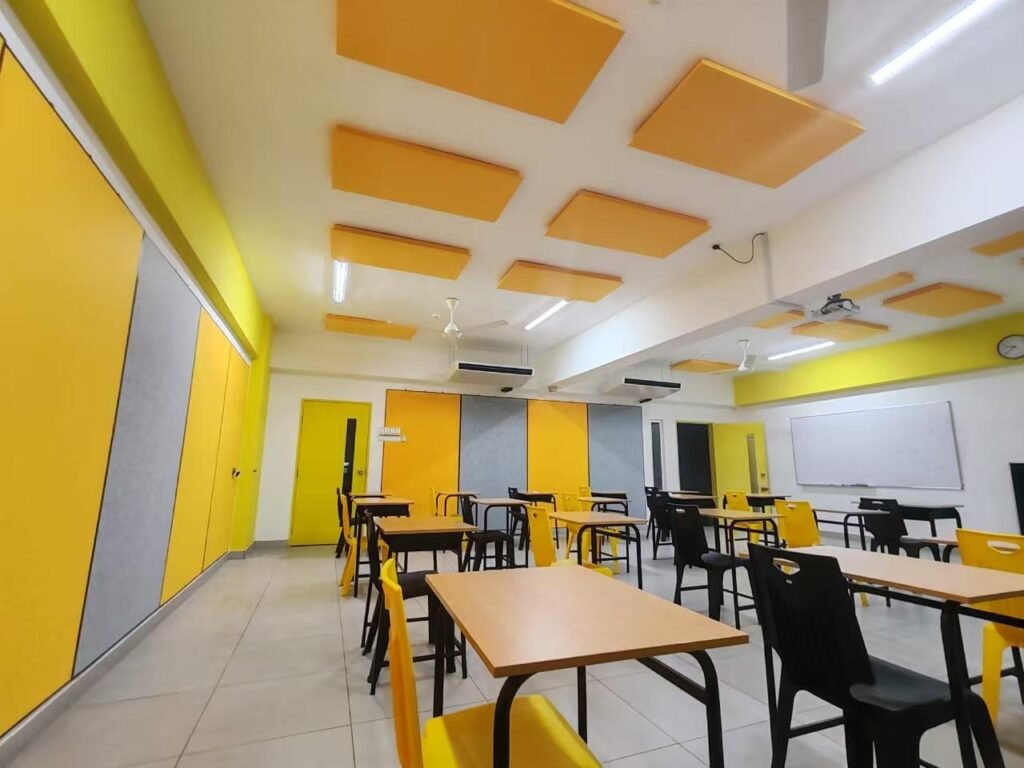
Schools and Libraries: Introduce sound-absorbing surfaces into classrooms, study areas, and shared learning environments.
Auditoriums and Conference Spaces: Combine decorative acoustic panels with a broader room acoustic design to manage reverberation.
Commercial Interiors: Create custom wall patterns, grooved panel designs, and decorative ceiling features that integrate acoustic treatment with interior architecture.
ES Acoustic offers PET acoustic wall and ceiling solutions for commercial architectural projects. Our product range supports custom colors, panel dimensions, CNC patterns, and application-specific designs.
Explore our PET Acoustic Wall Panels and 3D PET Acoustic Wall Panels to find suitable options for your project.
Our office acoustic projects also demonstrate how polyester panels integrate with modern workplace interiors.
Looking for PET acoustic panels for your next project?
Contact ES Acoustic to discuss panel specifications, custom finishes, acoustic requirements, and architectural applications.