Address
No.55-6, Denggang, Middle of Lishui Avenue, Lishui Town, Nanhai District, Foshan City, Guangdong Province, China.
Work Hours
Mon to Fri: 7:00AM - 18:00PM
Weekend: 10:00AM - 18:00PM

Address
No.55-6, Denggang, Middle of Lishui Avenue, Lishui Town, Nanhai District, Foshan City, Guangdong Province, China.
Work Hours
Mon to Fri: 7:00AM - 18:00PM
Weekend: 10:00AM - 18:00PM


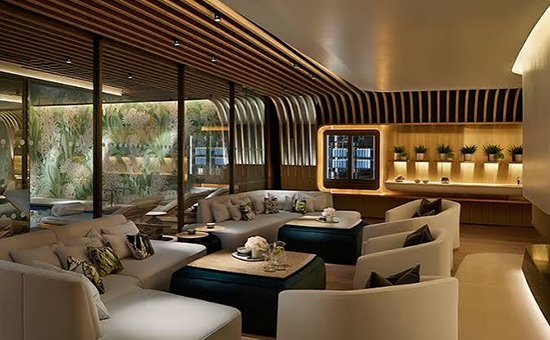
A hotel needs more than attractive interiors to create a comfortable guest experience. Noise from conversations, restaurants, corridors, mechanical equipment, and other rooms can quickly affect how guests perceive a space. At the same time, large public areas such as lobbies, ballrooms, and restaurants can suffer from excessive reverberation when designers use too many hard finishes.
Hotel acoustic design helps address these problems by considering room function, noise sources, reverberation, sound absorption, and the relationship between architectural finishes and acoustic performance.
Rather than adding acoustic panels after construction, an effective approach considers acoustics as part of the overall interior and architectural design from the beginning.
Hotels contain many different spaces, and each one has its own acoustic requirements.
A guest room needs a quiet environment and good privacy. A restaurant needs to control conversations and background noise without making the space feel visually enclosed. A conference room needs clear speech, while a ballroom or large event space requires careful control of reverberation.
The acoustic strategy therefore needs to match the function of each space.
Common acoustic challenges in hotels include:
A well-planned hotel acoustic treatment strategy can address these issues while supporting the architectural appearance of the interior.
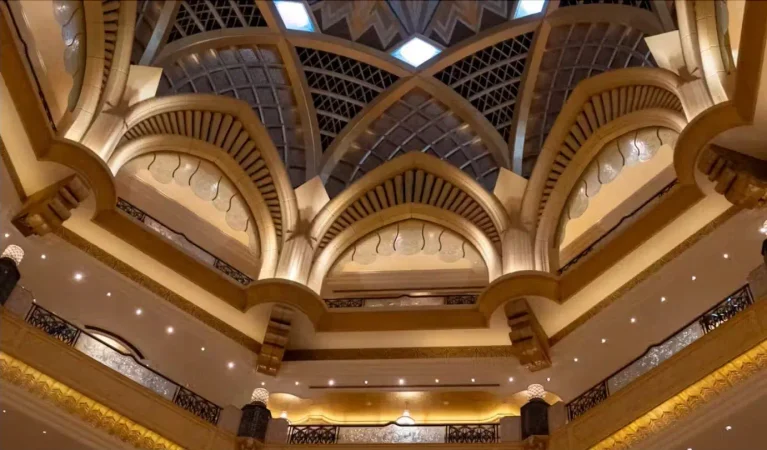
The lobby creates the first impression of a hotel, so designers often use stone, glass, wood, metal, and other durable finishes. These materials can produce strong sound reflections when used across large surfaces.
Hotel lobby acoustic treatment can combine ceiling and wall absorption to control reverberation while maintaining the visual character of the space.
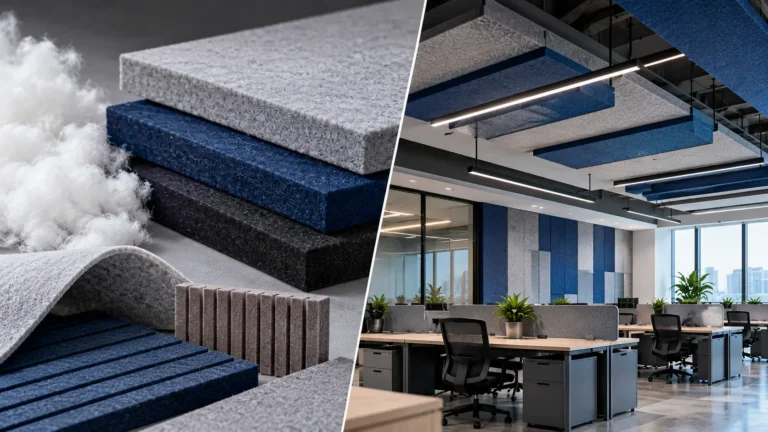
Suspended acoustic clouds, PET acoustic panels, decorative wall panels, and other integrated solutions can provide sound absorption without turning the lobby into a visibly “acoustic” environment.
The placement of treatment also matters. Large uninterrupted reflective surfaces may require more attention than areas that already contain furniture, curtains, carpets, or other sound-absorbing elements.
Guest rooms require a different acoustic approach because privacy and noise control become more important.
Acoustic design can consider sound transmission through walls, doors, ceilings, floors, and service areas. Acoustic insulation, composite sound insulation boards, acoustic doors, and properly detailed wall and ceiling systems can help reduce unwanted sound transmission.
Corridors also deserve attention because footsteps, conversations, luggage movement, and door operation can create noise that reaches guest rooms.
In these areas, acoustic treatment should work together with the building’s sound insulation and construction details rather than relying only on decorative acoustic panels.
Restaurants often combine many hard surfaces with high levels of speech and activity. When sound absorption is insufficient, conversations can become louder as people try to hear each other.
For restaurant acoustic design, the goal is not simply to make the room quieter. The treatment should help create a comfortable balance between speech clarity, background noise, reverberation, and visual design.
Acoustic ceiling baffles, suspended acoustic clouds, fabric panels, and PET acoustic panels can work well in restaurants because they can integrate into different ceiling and interior concepts.
Conference rooms require clear communication. Excessive reverberation can make speech harder to understand, particularly when several people participate in a meeting or presentation.
A combination of ceiling and wall absorption can help control reflections around the main speaking and listening areas.
The acoustic design should also consider room size, ceiling height, furniture, glazing, doors, and background noise. For projects with higher acoustic requirements, designers can use acoustic calculations and room measurements to determine the appropriate treatment area and placement.
Ballrooms present a different challenge because of their large volume and flexible use.
The same room may host conferences, weddings, banquets, performances, or other events. These activities can have very different acoustic requirements.
Large spaces often need careful control of reverberation and sound reflections. Suspended acoustic elements can be particularly useful because they increase the effective sound-absorbing area while working with high ceilings.
Wood acoustic panels, fabric acoustic panels, PET acoustic baffles, acoustic clouds, and sound diffusers can be combined depending on the required acoustic performance and interior concept.
There is no single acoustic panel that works for every hotel space. Material selection should follow the acoustic requirement, interior design, installation conditions, and project budget.
PET acoustic panels work well for many hospitality interiors because they offer design flexibility in colors, shapes, and suspended configurations.
Wood acoustic panels can support warm and natural interior concepts while providing sound absorption when designed with an appropriate acoustic backing system.
Fabric acoustic panels provide another flexible option for walls and feature areas, particularly where designers want a wide range of colors and finishes.
For high-ceiling spaces, acoustic baffles and suspended acoustic clouds can provide additional sound-absorbing surfaces without occupying valuable wall space.
In spaces that require more control over sound reflections, acoustic diffusers can complement absorptive materials by helping manage reflected sound rather than simply absorbing it.
The right combination depends on the acoustic objectives of the space.
A common mistake in acoustic projects is choosing acoustic panels first and deciding where to install them afterward.
A more effective process starts with the room itself.
The design team can first identify the main noise sources, room dimensions, surface finishes, expected occupancy, and acoustic requirements. From there, the project team can determine where absorption, sound insulation, diffusion, or noise control will provide the greatest benefit.
For example, a hotel restaurant may require more sound absorption at the ceiling, while a guest room may require greater attention to sound transmission through walls and doors. A ballroom may require a combination of suspended absorption and controlled diffusion.
This design-first approach to hotel acoustic treatment helps ensure that acoustic products become part of a complete solution rather than isolated decorative elements.
Hotel acoustic design often involves more than selecting acoustic panels. Depending on the project, the solution may include:
For new hotels and major renovations, coordinating these elements during the design stage can help avoid acoustic problems that become difficult or expensive to correct later.
At ES Acoustic, we approach hotel projects by connecting acoustic requirements with the architectural space, material selection, and project conditions. Our solutions can cover public areas, guest rooms, restaurants, conference spaces, ballrooms, and other hospitality environments.
Good hotel acoustics should support the entire guest experience, from a comfortable lobby to a quiet guest room and a clear conference or event space.
The most effective hotel acoustic design does not rely on one product or one treatment method. It combines room analysis, appropriate acoustic materials, strategic placement, and coordination with the architectural design.
By treating acoustics as part of the project from the beginning, hotel designers, contractors, and project teams can create spaces that look refined while providing a more comfortable acoustic environment.