Address
No.55-6, Denggang, Middle of Lishui Avenue, Lishui Town, Nanhai District, Foshan City, Guangdong Province, China.
Work Hours
Mon to Fri: 7:00AM - 18:00PM
Weekend: 10:00AM - 18:00PM

Address
No.55-6, Denggang, Middle of Lishui Avenue, Lishui Town, Nanhai District, Foshan City, Guangdong Province, China.
Work Hours
Mon to Fri: 7:00AM - 18:00PM
Weekend: 10:00AM - 18:00PM


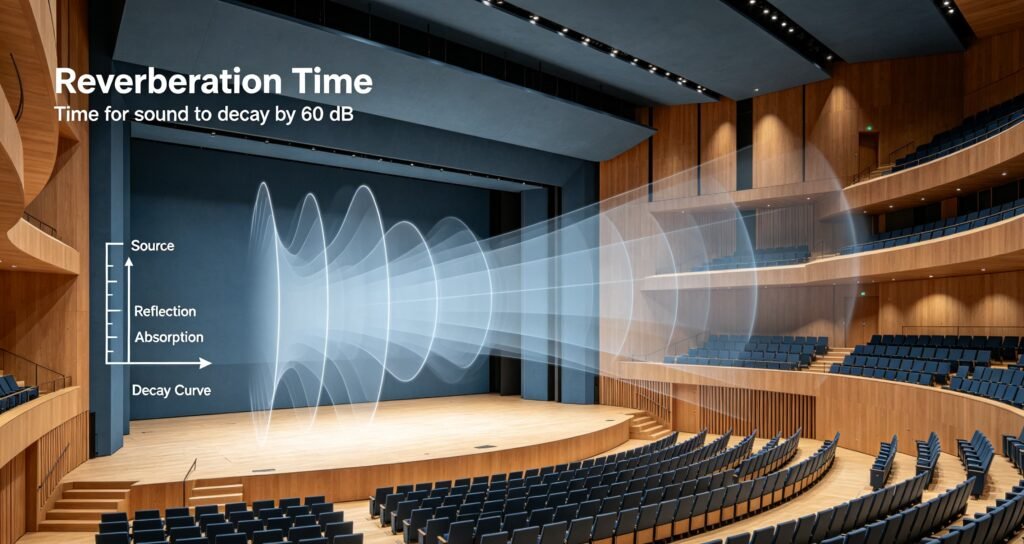
When people enter a large auditorium, lecture hall, hotel ballroom, conference room, or other architectural space, they often notice the acoustic environment before they consciously think about it. Speech may sound clear and comfortable, or voices may continue to linger after the speaker stops talking, creating an environment that feels loud, unclear, or difficult to understand.
One of the important parameters that acoustic professionals use to evaluate this behavior is reverberation time.
Understanding reverberation time helps architects, contractors, consultants, and project teams make better decisions about acoustic treatment because it provides a way to evaluate how quickly sound energy decays inside a room. It also helps explain why simply adding an acoustic panel is not always enough and why the location, amount, and type of sound absorption should relate to the function and geometry of the space.
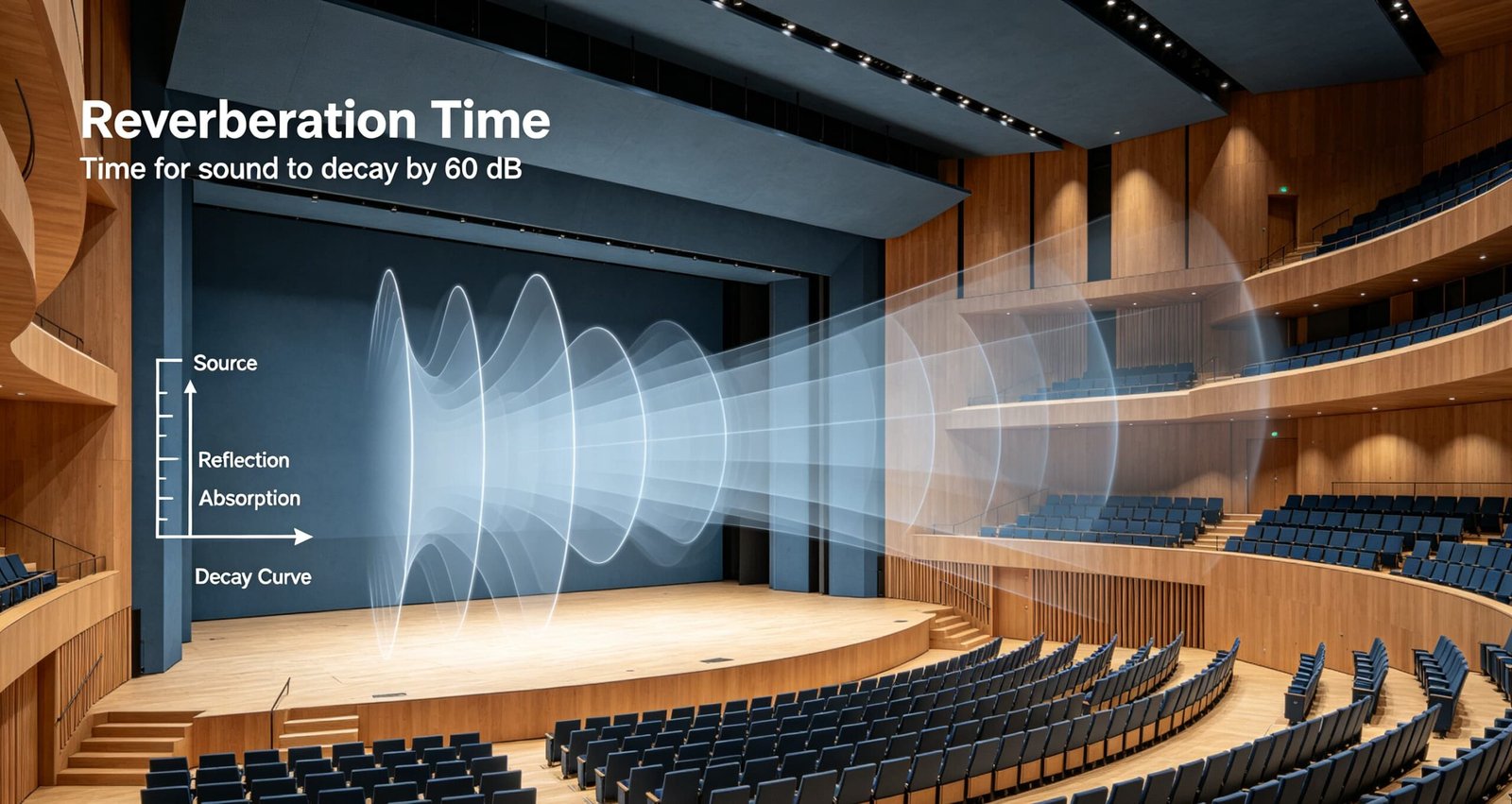
Reverberation time, commonly referred to as RT60, describes the time required for the sound level in a room to decrease by 60 decibels after the sound source stops.
When someone speaks, plays music, or uses a sound system inside a room, sound waves travel directly to listeners while also reflecting from walls, ceilings, floors, and other surfaces. These reflections continue for a period of time after the original sound stops, and the combination of direct sound and reflected sound creates the acoustic character of the room.
A room with many hard, reflective surfaces tends to retain sound energy for longer, while a room with sufficient sound-absorbing surfaces can reduce reflected sound more quickly.
ISO 3382-1 specifies methods for measuring reverberation time and other room acoustic parameters in performance spaces, while ISO 3382-2 addresses reverberation time measurement in ordinary rooms. These standards provide measurement procedures and methods for evaluating room acoustic conditions.
Reverberation time matters because the acoustic requirements of a room depend strongly on how people use the space.
In a lecture hall, for example, listeners need to understand spoken words clearly. Excessive reverberation can allow reflections from previous words or syllables to overlap with new speech, making communication more difficult.
A music venue has different requirements because designers may want the room to support a particular balance between direct sound, early reflections, and reverberant energy. A hotel ballroom, conference room, classroom, cinema, or mosque may also require a different acoustic approach according to its size, occupancy, activities, architectural finishes, and sound system.
For this reason, there is no single ideal reverberation time for every room. The appropriate acoustic target depends on the function and design of the space.
This distinction is important for project teams because acoustic treatment should begin with the room’s purpose and acoustic objectives rather than with a specific acoustic product.
Room surfaces play an important role in determining how sound behaves.
Materials such as glass, stone, concrete, ceramic finishes, and many hard architectural surfaces reflect a significant portion of incident sound energy. When a large room contains many of these surfaces and has relatively little sound absorption, sound can remain audible for longer after the original source stops.
Room volume also matters. A large space contains more air volume and often requires a carefully planned distribution of sound absorption to control the acoustic response.
Other factors include:
The combination of these factors means that two rooms with similar dimensions can still produce noticeably different acoustic environments.
Sound absorption reduces the amount of sound energy that continues to reflect within a room.
When sound reaches an absorptive surface, part of the acoustic energy enters the material rather than returning entirely into the room. Increasing the appropriate amount of sound absorption can therefore shorten reverberation time and help control excessive reflections.
However, acoustic designers need to consider where they place absorptive materials as well as how much absorption they introduce.
For example, a large auditorium may require a combination of wall and ceiling treatment rather than concentrating all absorption on a single surface. In some projects, designers may also combine sound absorption with diffusion or other acoustic elements to create a more balanced acoustic environment.
This is why professional acoustic design looks at the room as a complete system rather than treating an acoustic panel as an isolated solution.
Reducing reverberation time usually involves increasing suitable sound absorption within the space while maintaining the acoustic characteristics required for its intended use.
Depending on the project, acoustic treatment may include:
Wall-mounted acoustic panels can provide additional sound absorption while also contributing to the architectural appearance of the room. Wood acoustic panels, fabric acoustic panels, PET acoustic panels, and other systems can serve different design and performance requirements.
The selection should consider the room function, required acoustic performance, fire requirements, finish, durability, and installation conditions.
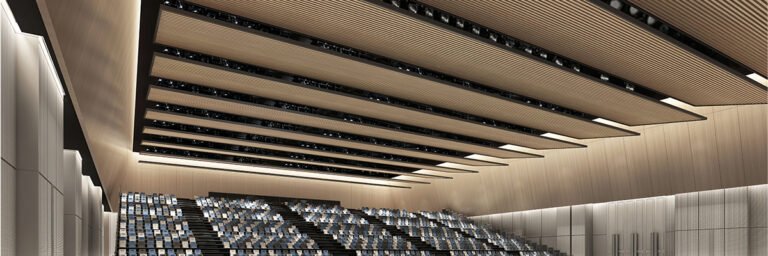
The ceiling often provides a large available surface for acoustic treatment, particularly in commercial interiors, offices, education spaces, and large public buildings.
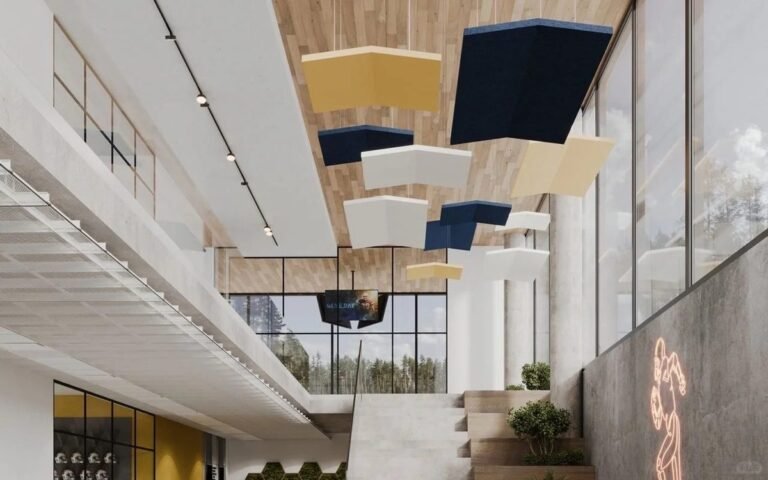
Acoustic baffles and acoustic clouds can introduce sound absorption without covering the entire ceiling with a continuous panel system. Their position and configuration can also become part of the interior design.
Large rooms often benefit from distributing acoustic absorption across different surfaces rather than placing all treatment in one location.
The appropriate approach depends on room geometry, sound source locations, listener positions, architectural finishes, and the acoustic objectives established for the project.
It can be tempting to assume that adding more acoustic absorption will always improve a room, but acoustic design requires more balance than that.
A space with excessive absorption can lose useful reflected sound and may feel acoustically unnatural for certain activities. Performance spaces, for example, may require carefully controlled reverberant energy rather than simply the lowest possible reverberation time.
This is particularly important for auditorium acoustic design, where speech, music, audience size, room volume, and architectural geometry all influence the desired acoustic environment.
A professional acoustic solution therefore aims to achieve the appropriate acoustic response for the room rather than simply maximizing sound absorption.
The importance of reverberation time changes according to the function of the building.
Auditoriums and theaters often require careful control of reverberation because both speech and music need to reach the audience with an appropriate balance of direct and reflected sound.
Acoustic wall panels, ceiling systems, diffusers, and other architectural acoustic treatments may work together depending on the design objectives.
In lecture halls and classrooms, speech intelligibility is a major consideration. Excessive reverberation can reduce clarity, particularly when several listeners sit far from the main speaker.
Acoustic treatment therefore needs to consider the room’s dimensions, seating arrangement, sound system, and reflective surfaces rather than relying on one type of material.
Hotel ballrooms, restaurants, lobbies, meeting rooms, and other hospitality spaces often combine hard architectural finishes with high occupancy levels.
An appropriate acoustic strategy can help manage reflected sound and create a more comfortable environment without compromising the visual character of the interior.
Open-plan offices require a broader approach to room acoustics. Reverberation time provides useful information, but it does not describe every aspect of acoustic performance in an open office.
ISO 3382-3:2022, for example, uses several parameters related to speech propagation, background noise, and spatial decay when evaluating open-plan office acoustics. The standard also recognizes that wall and ceiling absorption, room geometry, furniture, screens, floor coverings, and background sound can influence the acoustic environment.
Cinema spaces require controlled reflections and a carefully designed acoustic environment so that the sound system can perform as intended.
The acoustic strategy may combine absorptive materials, reflective surfaces, diffusion, wall construction, ceiling treatment, and other measures according to the room design and performance requirements.
Acoustic professionals typically measure reverberation time by generating a suitable sound field in the room and analyzing how the sound energy decays after the source stops.
The measurement process involves appropriate sound sources, microphones, measurement positions, and data analysis. ISO 3382 standards describe procedures for measuring reverberation time and related room acoustic parameters, including requirements for measurement coverage and evaluation.
For a project, measurement results can help the acoustic team understand the existing room condition and compare it with the project’s acoustic requirements.
This information becomes particularly useful when an existing building already has an acoustic problem and the project team needs to determine how much treatment the room actually requires.
Reverberation time demonstrates an important principle in architectural acoustics: the right acoustic material depends on the problem that the project needs to solve.
A contractor may have access to many different acoustic products, but the most suitable solution depends on factors such as room volume, surface finishes, frequency characteristics, architectural requirements, fire performance, installation conditions, maintenance, and budget.
For example, a project may use micro-perforated wood panels where architectural appearance and acoustic treatment need to work together, while another space may benefit from PET acoustic panels, fabric absorbers, acoustic baffles, or suspended acoustic elements.
The product itself is only one part of the overall acoustic strategy.
A practical acoustic design process normally starts by understanding the room, its function, and its existing acoustic conditions.
The project team can then identify the main acoustic issues, establish appropriate performance objectives, determine where sound absorption or other acoustic treatment should be introduced, and select materials that fit the architectural and construction requirements.
This approach allows acoustic products to become part of a coordinated solution rather than an isolated specification.
For complex projects such as auditoriums, theaters, hotels, conference centers, educational buildings, and large public spaces, the acoustic strategy may also need to coordinate with architectural design, mechanical systems, lighting, fire requirements, structure, and construction details.
Reverberation time is one of the fundamental concepts in room acoustic design, but it should not become the only parameter used to judge a space.
Understanding RT60 helps project teams recognize how room volume, surface materials, sound absorption, occupancy, and architectural design influence the way sound behaves inside a space. From there, acoustic designers can determine whether the project needs wall treatment, ceiling absorption, acoustic baffles, diffusers, architectural panels, or a combination of different systems.
The most effective acoustic solution does not simply add the largest possible amount of absorption. Instead, it considers the function of the room, the behavior of sound, the architectural design, and the practical requirements of the project before selecting the appropriate acoustic treatment.
For contractors, architects, and project developers, this approach can make acoustic design more predictable and help create spaces that support speech, music, communication, and occupant comfort.
Planning an acoustic treatment project? Our team can help assess your project requirements and develop an acoustic solution that balances acoustic performance, architectural design, and practical installation requirements.